

The Seedsun selection
Parrotia persica
SKU: PARO-PERS-01G
There is a moment in late winter, before anything else in the garden has stirred, when Parrotia persica opens the first flowers. They have no petals, just a tight cluster of crimson stamens emerging from scaled buds along bare grey branches, small and startling against the cold. Most people walk.
Ask for a tailored quote
Pricing, pack sizes and availability are confirmed in your personal quotation. Sending an enquiry does not place a paid order.
Ask about suitability, sowing and growing requirements.
Confirm delivery options and required documents in your quote.
About this variety
There is a moment in late winter, before anything else in the garden has stirred, when Parrotia persica opens the first flowers. They have no petals, just a tight cluster of crimson stamens emerging from scaled buds along bare grey branches, small and startling against the cold. Most people walk past them. The ones who stop tend to become collectors.
Native to the forests along the southern shores of the Caspian Sea, Parrotia has been part of the horticultural conversation long enough that serious gardeners know the tree well, and yet Persian ironwood still has not found a way into nearly enough gardens. That seems like a problem worth solving.
The bark is the thing that stops people cold. On mature specimens the bark exfoliates in irregular plates the way a sycamore or stewartia does, revealing an understory of cream, grey, olive, and warm tan, a patchwork that grows more complex and more beautiful every year. The canopy is broadly spreading, often wider than tall, with a layered architecture that reads as sculpture in winter once the leaves have dropped.
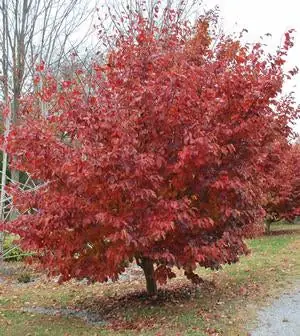
And then the leaves turn in a manner worth discussing. Few trees offer fall color of this intensity across such a range, burgundy deepening to scarlet, orange bleeding into gold, sometimes all of it on the same branch at the same time. In a good autumn the display is, without exaggeration, one of the finest things growing in the temperate garden.
Parrotia persica is hardy, adaptable to a range of soils, and largely indifferent to urban conditions, qualities that, combined with everything else the tree offers, make the rarity genuinely hard to explain. We don't have an answer. We do have the tree.
More to discover



Questions & discussion