

The Seedsun selection
Rhododendron serrulatum
SKU: RHOD-SERR-01G
The native deciduous azaleas of the southeastern United States bloom in a long relay, from the pinxters and Piedmont azaleas of March through the flame azaleas of April and May and on into July with the red of Rhododendron prunifolium. And then, once most gardeners have closed the azalea chapter.
Ask for a tailored quote
Pricing, pack sizes and availability are confirmed in your personal quotation. Sending an enquiry does not place a paid order.
Ask about suitability, sowing and growing requirements.
Confirm delivery options and required documents in your quote.
About this variety
The native deciduous azaleas of the southeastern United States bloom in a long relay, from the pinxters and Piedmont azaleas of March through the flame azaleas of April and May and on into July with the red of Rhododendron prunifolium. And then, once most gardeners have closed the azalea chapter for the year, Rhododendron serrulatum opens. Hammocksweet azalea is the last of the line, flowering in August and September and sometimes later still.
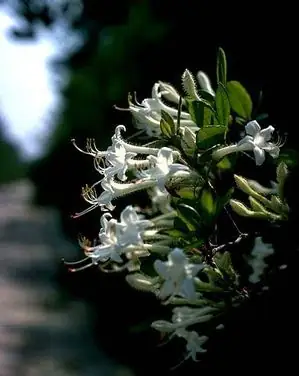
The flowers are white, narrowly tubular, and carried in clusters at the stem tips long after the foliage has expanded, an arrangement easy to overlook in a catalog and impossible to overlook in a garden. On a warm, humid afternoon the fragrance arrives before the eye does, sweet and clean in the manner of honeysuckle but rounder and more complex, and carrying a surprising distance. This is the reason serious collectors of native azaleas count hammocksweet essential; whatever the flowers may lack in spring flash they repay in late-season scent, feeding hummingbirds, native bees, and sphinx moths when little else in the shrub layer is in bloom.
The taxonomy is worth a sentence, since the references do not agree. Some authorities fold Rhododendron serrulatum into R. viscosum as a variety, while others hold the plant apart as a full species. has long argued for the latter, and the argument holds up: the two differ in habit, in flowering time, in native range, and in several botanical details. R. viscosum blooms in June and July, tops out near eight feet, and favors bogs and wet flatwoods, while R. serrulatum blooms in August and September, can rise to ten or fifteen feet, and grows in gallberry thickets, along blackwater streams, and on the slightly raised ground within a wetland that Floridians call a hammock, which is where the common name comes from. The two are close kin, but they are not the same plant, and growing both is the point.
Ranging farther south than any other native deciduous azalea, deep into central Florida where few relatives follow, hammocksweet is the better adapted of the two to the heat and humidity of the Deep South. Grow the shrub at the back of a moist border, along a woodland margin, or beside a pond or rain garden, where the tall, upright, open frame gives structural presence without density and the roots find the steady moisture the plant needs. Site where the August fragrance can be caught along a path or from a seat on a summer evening, and pair with Clethra alnifolia, which overlaps in bloom and shares the taste for moist, acidic soil, for a late-summer fragrance no other pairing quite matches. Every part is poisonous if eaten, as with all azaleas, so grow the plant for scent and not for the table.
More to discover



Questions & discussion