

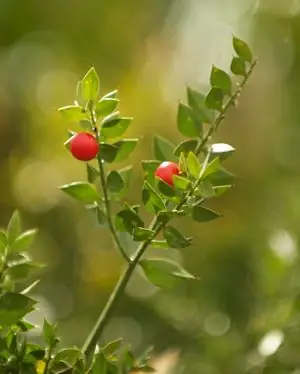
The Seedsun selection
Ruscus aculeatus
SKU: RUSC-ACUL-01G
Ruscus aculeatus, Butcher's Broom, is a low evergreen shrub of the asparagus family, native to the woodlands of southern Europe, the Mediterranean, and the Middle East, and reaching north into the milder parts of the British Isles. What look like glossy, spine-tipped leaves are not leaves at all.
Ask for a tailored quote
Pricing, pack sizes and availability are confirmed in your personal quotation. Sending an enquiry does not place a paid order.
Ask about suitability, sowing and growing requirements.
Confirm delivery options and required documents in your quote.
About this variety
Ruscus aculeatus, Butcher's Broom, is a low evergreen shrub of the asparagus family, native to the woodlands of southern Europe, the Mediterranean, and the Middle East, and reaching north into the milder parts of the British Isles. What look like glossy, spine-tipped leaves are not leaves at all but flattened stems called cladodes, which take over the work of photosynthesis while the true leaves are reduced to tiny scales. The generic name comes from the Latin ruscum, the old word for a butcher's broom, and the epithet aculeatus means prickled, for the sharp point that tips each cladode.
In spring, small greenish-white, six-tepaled star-shaped flowers appear singly or in pairs in the very center of each cladode, an arresting detail once noticed. The species is dioecious, so male and female flowers grow on separate plants, and only the female bears fruit: bright red berries set directly on the face of the cladode, holding from late fall through winter against the dark green. These are seed-grown plants and so include both sexes, unlike many of the unisexual clones sold in the United States that never fruit, and with a male and a female planted together a berry crop is likely.
The common name is earned. The tough, wiry stems and bristled tips were once bound into stiff brooms that butchers used to scour scraps and blood from their blocks and stalls, and the plant has carried the country name Knee Holly as well. Old herbals put the plant to work internally too: the rhizome and root have a long European history in the treatment of venous complaints, and modern research has isolated the steroidal saponins ruscogenin and neoruscogenin as the active agents behind that reputation. The medicinal thread is developed further in the fields below.
In the garden Butcher's Broom does the difficult work few shrubs will take on. The plant thrives in heavy, dry shade, shrugs off root competition, and holds a tidy evergreen presence beneath trees, along a woodland edge, or in the sooty, sunless corners of a city garden where little else persists. Slow and long-lived, drought-tolerant once settled, and left alone by deer, this is a shrub to plant and largely forget, rewarded each winter by the red berries lit against the dark cladodes.
More to discover



Questions & discussion