

The Seedsun selection
Vaccinium crassifolium ‘Bloodstone’
SKU: VACC-CRAS-BLOO-01G
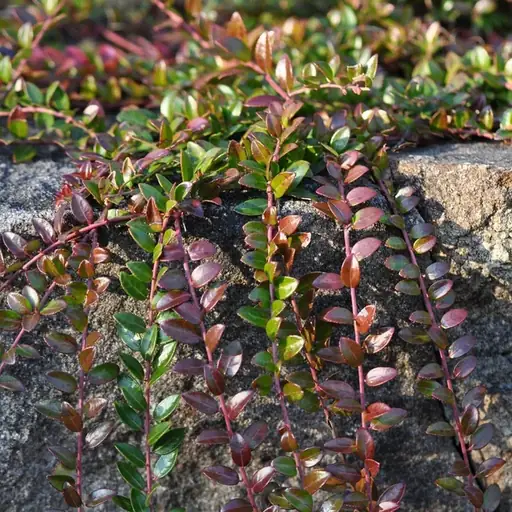
Creeping blueberry runs flat. Vaccinium crassifolium ‘Bloodstone’ makes a dense evergreen mat five to eight inches deep, the trailing stems rooting and swelling into small woody burls wherever they touch ground, so a single plant knits outward year on year into a carpet. The leaves are thick and.
Ask for a tailored quote
Pricing, pack sizes and availability are confirmed in your personal quotation. Sending an enquiry does not place a paid order.
Ask about suitability, sowing and growing requirements.
Confirm delivery options and required documents in your quote.
About this variety
Creeping blueberry runs flat. Vaccinium crassifolium ‘Bloodstone’ makes a dense evergreen mat five to eight inches deep, the trailing stems rooting and swelling into small woody burls wherever they touch ground, so a single plant knits outward year on year into a carpet. The leaves are thick and leathery and hold a semi-gloss, broader and rounder than the species runs, closer in texture to periwinkle than to anything most people picture when they hear the word blueberry. In winter the late-maturing foliage takes on a reddish cast and the stems darken to a distinct red, which is where the name comes from. This is a winter plant, not a spring one, and the color is the whole argument.
This evergreen creeping blueberry is a North Carolina State University selection. Benson Kirkman and Jim Ballington found the clone in a wild stand in 1979 and described the pair formally in HortScience in 1985 alongside ‘Well’s Delight’, which Ballington had taken from Moore County, North Carolina in the same year. Those two were the first creeping blueberry cultivars ever named, and J. C. Raulston later put both on his list of fifty great uncommon plants, predicting they could become major landscape plants across much of the country. Four decades on that prediction remains mostly unfulfilled, which is a fair summary of how American gardening treats its own groundcovers. The plants offered here are our own propagation, grown on at the nursery in Aiken.
There is a taxonomic knot worth untying, because two plants in this catalog are involved. The population ‘Bloodstone’ came from is the one Rayner and Henderson described in 1980 as Vaccinium sempervirens, and Kirkman and Ballington filed the cultivar under V. crassifolium subspecies sempervirens. Kew and the Flora of North America now sink that name into V. crassifolium outright; the Flora of the Southeastern United States keeps V. sempervirens at species rank. The plants have not moved, only the labels. Small urn-shaped flowers, red in bud and opening pink and white, hang in short clusters in April and May, and the Xerces Society lists creeping blueberry as being of special value to native bees, with seven specialist species recorded. Purple-black berries follow in June and July. They are edible and they are dull, and anyone growing this plant for fruit has chosen the wrong blueberry.
Plant ‘Bloodstone’ where the ground is acid, sandy and sharply drained, through a pine bark mulch, in the longleaf pine palette of a Carolina sandhill: full sun for the best winter color, part shade accepted. Space two feet apart for a closed carpet in a few seasons, on a slope, a bank, a raised bed or the front of a border where the mat can be seen. Three cautions, all of them from the people who selected the plant. Drainage is not negotiable, and this cultivar in particular is prone to Phytophthora and to leaf and stem anthracnose in ground that stays too wet. Over-fertilization is the single commonest cause of failure. And the roots resent disturbance, so plant from a container and then leave the plant alone. Never lime the bed.
More to discover



Questions & discussion