

The Seedsun selection
Viburnum propinquum
SKU: VIBU-PROP-01G
A viburnum grown for the leaves rather than the flowers, and one of the rarest evergreens in the American nursery trade. Viburnum propinquum was described by the botanist William Hemsley in 1888 from the temperate forests of China, and the plant ranges through central and southern China, Taiwan,.
Ask for a tailored quote
Pricing, pack sizes and availability are confirmed in your personal quotation. Sending an enquiry does not place a paid order.
Ask about suitability, sowing and growing requirements.
Confirm delivery options and required documents in your quote.
About this variety
A viburnum grown for the leaves rather than the flowers, and one of the rarest evergreens in the American nursery trade. Viburnum propinquum was described by the botanist William Hemsley in 1888 from the temperate forests of China, and the plant ranges through central and southern China, Taiwan, and north to Luzon in the Philippines. The species name comes from the Latin propinquus, meaning near or akin, a botanist's nod to the plant's close kinship with several related Asian viburnums. is among the very few nurseries anywhere to offer the Chinese evergreen viburnum.
The foliage is the whole reason to grow this shrub. Narrow, elliptic, and three-veined, the leaves emerge coppery and settle to a lustrous dark green, leathery and neat, held on arching branches that give the rounded frame a quiet, architectural poise the year round. Few broadleaf evergreens read as cleanly at close range, and the polished leaves catch light in a shaded border where duller foliage would disappear.
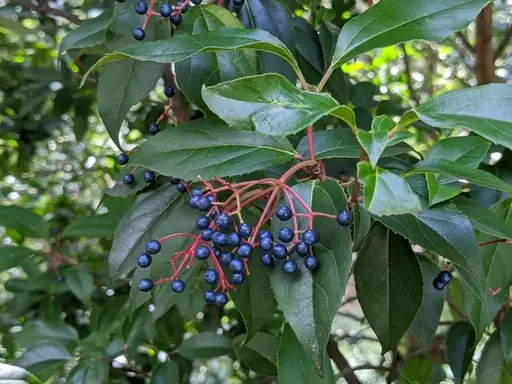
In spring the shrub carries small, flat-topped clusters of greenish-white flowers, modest against the leaves but useful to the season's first pollinators. By late summer and fall the flowers give way to glossy blue-black berries that gleam among the dark foliage and feed birds through the cooler months. The bloom and fruit are understated by design; this is a plant that trades floral drama for evergreen composure.
Reaching six to eight feet in height and spread, the Chinese evergreen viburnum wants moist, well-drained soil and the shelter of part to full shade, which makes the plant a natural for a woodland understory or a shaded foundation across the mild South and other temperate gardens. Both deer-resistant and drought-tolerant once settled, the shrub asks little and gives year-round structure, a connoisseur's evergreen for the collector and the designer alike.
Photo courtesy of 莊燿鴻.
More to discover



Questions & discussion